


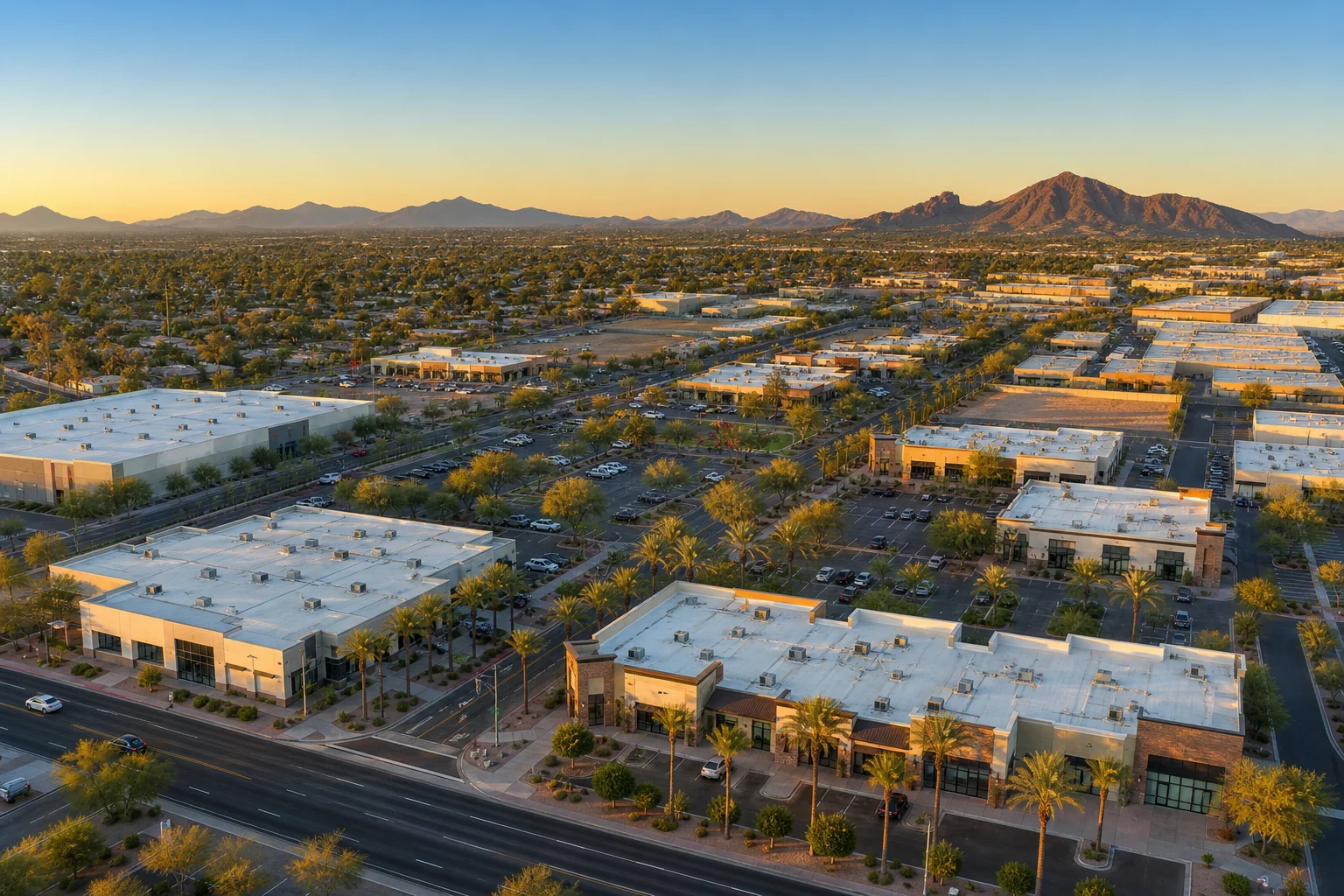
The best 1031 exchange strategy for Arizona investors centers on building a replacement property pipeline before the sale closes, not after. Timing is governed by strict Internal Revenue Code deadlines: 45 days to identify and 180 days to close. Investors who front-load the process protect equity and preserve deal optionality across the Phoenix metro.
By David Pierce, MHG Commercial
Why a Replacement Property Pipeline Defines Your 1031 Exchange Results
A solid 1031 exchange strategy for Arizona investors begins before the listing agreement is signed. Most real estate investors treat the replacement property search as step two. It should be step zero.
Arizona's commercial real estate market moves fast. According to CBRE's 2024 Phoenix Industrial Marketview, East Valley industrial product continues to absorb faster than new supply arrives, keeping vacancy tight across Chandler, Mesa, and Gilbert. Quality retail centers in those submarkets often trade quietly before they reach public listings. If you wait until escrow closes on your relinquished property to start looking, you have 45 calendar days to identify a replacement property, a window that closes regardless of holidays, seller responsiveness, or due-diligence complexity.
A pipeline is a pre-qualified shortlist of properties you have already toured, underwritten, and ranked by fit. It exists before your property lists. It narrows within the first two weeks of your identification period. That discipline separates investors who execute clean exchanges from those who take partial boot or miss the deadline entirely.
The Internal Revenue Code Framework Every Arizona Investor Must Know
Section 1031 of the Internal Revenue Code allows real estate investors to defer capital gains taxes when they swap one investment property for another of like-kind. The IRS does not define like-kind narrowly for real property: improved commercial land can exchange into raw land, retail into industrial, multifamily into office. The asset must be held for productive use in trade, business, or investment.
Treasury Regulations Section 1.1031(k)-1, in place since 1991, codify the deadlines that govern every exchange. The 45-day identification rule requires that you formally identify potential replacement properties in writing to your qualified intermediary no later than midnight of the 45th day following the close of your relinquished property. The 180-day exchange period requires that you close on at least one identified replacement property within 180 days of that same closing date, or by your tax return due date for the exchange year, whichever is earlier.
Filing for an extension can push the tax return deadline, but it does not extend the 180-day exchange period. These are statutory limits under internal revenue law, not negotiable deadlines.
Building a Replacement Property Pipeline: 1031 Exchange Strategy for Arizona Investors
For investors working with deal sizes from $1 million to $50 million in the Phoenix metro, a functional pipeline typically contains three to five properties at different stages of qualification.
Tier 1: Active targets. Properties where you have reviewed the offering memorandum, received financials, and could submit a letter of intent within seven days. Carry two to three of these at all times.
Tier 2: Backup candidates. Properties that fit your investment criteria but need more diligence before a formal offer. They provide depth if Tier 1 targets fall through or go under contract with another buyer.
Tier 3: Market inventory. Track active listings and off-market relationships in your target submarkets. Scottsdale retail, Tempe industrial, and Gilbert mixed-use parcels are worth monitoring even when they are not immediately actionable.
The identification rules give investors three main options. The three-property rule lets you identify up to three replacement properties without regard to value. The 200% rule lets you identify any number of properties as long as their combined fair market value does not exceed 200% of the relinquished property's value. The 95% rule allows unlimited identification if you close on 95% of the total identified value. Most real estate investors use the three-property rule because it forces prioritization and keeps the process clean.
The Qualified Intermediary: Structure, Selection, and Requirements
A qualified intermediary is not optional. Section 1031 requires that exchange proceeds never pass through your hands. If you receive the sale proceeds directly, even momentarily, the exchange is disqualified and capital gains become immediately taxable.
The qualified intermediary holds the proceeds from your relinquished property sale, then uses those funds to acquire the replacement property on your behalf. They must be independent: not your attorney, accountant, real estate agent, or anyone who has served in those roles for you in the prior two years.
The qualified intermediary also receives your written identification notice before the 45-day deadline. That notice is a legal document. It must name replacement properties with enough specificity for the IRS to identify them, typically by address, legal description, or distinguishing name. Vague identifications are disqualified.
In Arizona, there is no state licensing requirement for qualified intermediaries. Due diligence falls entirely on the investor. Ask prospective intermediaries how they hold exchange funds, whether in a commingled account or a segregated escrow, and whether they carry errors-and-omissions insurance. Select one with a dedicated escrow account structure and adequate fidelity bond coverage before you list your relinquished property.

Deferring Capital Gains Taxes and Managing Boot
The tax benefit of a 1031 exchange is deferral, not elimination. When you eventually sell the replacement property without another exchange, the deferred capital gains taxes become due. Many real estate investors use successive exchanges, sometimes called swap until you drop, then rely on the stepped-up basis at death under current estate law to reduce long-term liability.
Boot is any value received in the exchange that does not qualify for deferral. It arises when you receive cash, non-like-kind property, or when the replacement property's value or debt assumption is lower than the relinquished property's. Boot is taxable in the year of the exchange.
To fully defer capital gains taxes, the replacement property must equal or exceed the relinquished property in value, and all net equity must be reinvested. If your relinquished property carried a $2 million mortgage and your replacement property carries $1.5 million in debt, the $500,000 mortgage relief is treated as boot and triggers a proportional tax event.
Depreciation recapture is a separate tax consideration. Under Section 1250 of the Internal Revenue Code, accumulated depreciation on real property is recaptured at a maximum federal rate of 25% upon sale. A 1031 exchange defers recapture tax alongside capital gains taxes, but real estate investors should model both when evaluating the full tax exposure of a potential sale.
Managing the taxes sale treatment of the relinquished asset requires working backward from your estimated gain, recapture exposure, and applicable Arizona income tax to determine the minimum replacement property value that avoids boot entirely.
Without deferral, the capital gains taxes on a commercial real estate sale can erode a significant portion of your equity. A well-structured 1031 exchange strategy for Arizona investors keeps that capital compounding inside the replacement property rather than flowing to federal and state tax authorities.
Frequently Asked Questions
What qualifies as a like-kind property in Arizona for a 1031 exchange?
For real estate investors in Arizona, like-kind means any real property held for investment or business use exchanged for another real property held for the same purpose under the internal revenue code. Industrial for retail, land for multifamily, commercial for commercial: all qualify. Primary residences and inventory properties held for sale to customers do not qualify.
What happens if I miss the 45-day identification deadline?
The exchange fails. The qualified intermediary releases proceeds to you, and capital gains taxes become immediately due on the full gain from the relinquished property sale. There is no cure period or extension available under the Internal Revenue Code. Missing this deadline is the most common and most costly error in a 1031 exchange.
Does a 1031 exchange defer Arizona state capital gains taxes?
Yes. A properly executed exchange defers both federal and Arizona state capital gains taxes on the relinquished property. Arizona taxes capital gains as ordinary income; confirm the current applicable rate with your CPA for the specific filing year. If you exchange into out-of-state property, Arizona may assert a clawback right on the deferred gain when that property is eventually sold.
What is boot and how do I avoid it?
Boot is any value received outside of like-kind real estate in the exchange, including cash proceeds or debt relief. To avoid boot, the replacement property must be equal or greater in value than the relinquished property, with all equity fully reinvested. Even a small cash distribution to balance value differences triggers a taxable event proportional to the boot received.
Can raw land or horse property qualify as a replacement property in Arizona?
Yes. Raw land and horse property held for investment or agricultural use qualify as like-kind real estate under Section 1031 of the Internal Revenue Code. Phoenix metro fringe parcels, agricultural land in Maricopa and Pinal counties, and development-ready sites in the East Valley are all viable replacement property options for investors trading out of income-producing assets.
Talk to Pierce CRE About Your Replacement Property Pipeline
Building a replacement property pipeline before you list is the single most important step in any 1031 exchange. Pierce CRE works with real estate investors across Chandler, Gilbert, Tempe, and Scottsdale on commercial acquisition strategy for retail, industrial, land, and multifamily transactions from $500,000 to $100 million. Contact our brokerage to map your exchange timeline and pipeline needs.