


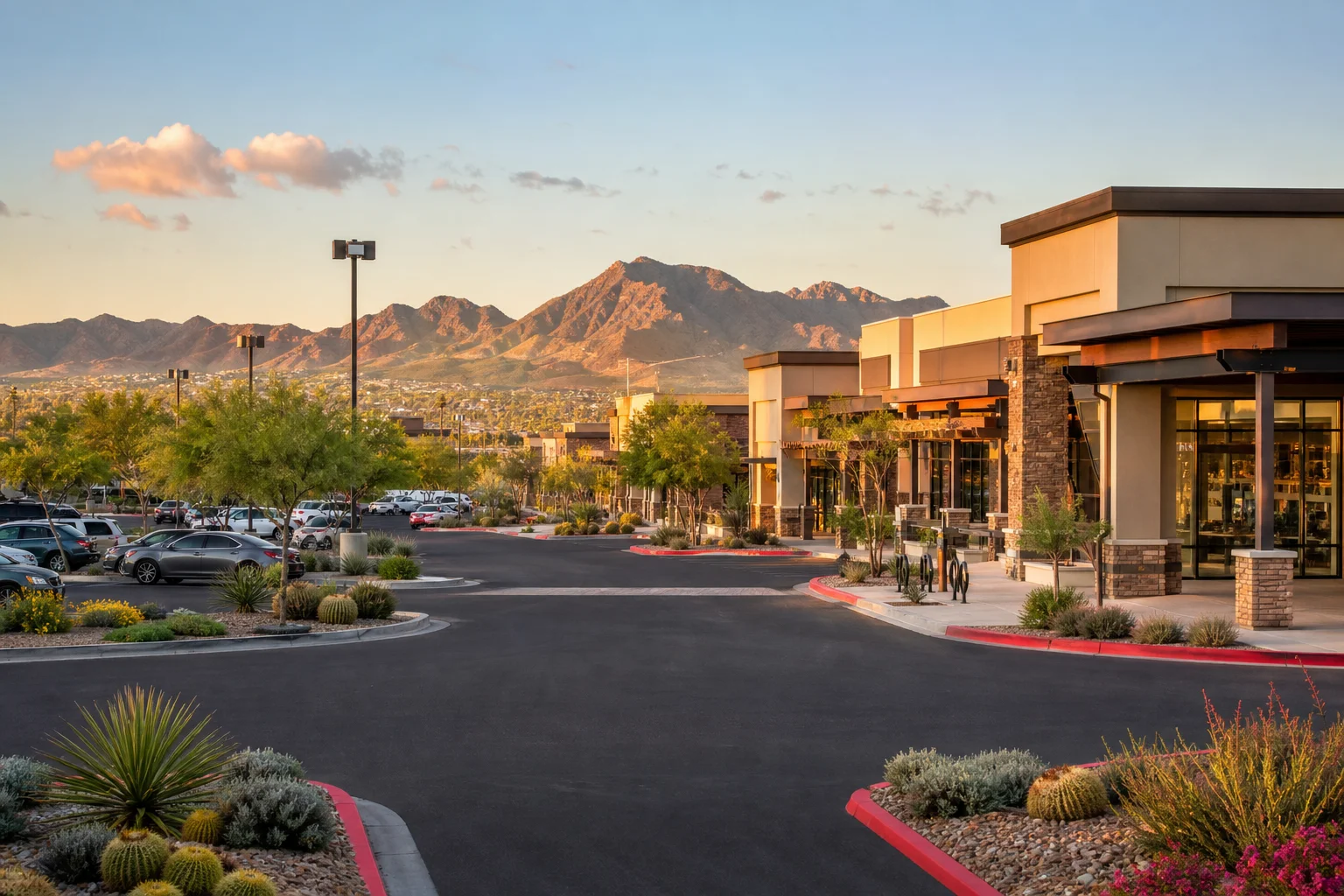
CAM reconciliation is the annual true-up where a landlord compares estimated common area maintenance payments to actual operating expenses and bills or credits the difference. Understanding how CAM reconciliation works and what a Mesa retail tenant should audit, from pro-rata share math to capital cost exclusions, helps protect margins on every retail leasing deal in the East Valley.
By David Pierce, MHG Commercial
What Common Area Maintenance Covers in a Mesa Retail Lease
Most Mesa retail leases define common area maintenance CAM charges as the landlord's cost of operating and maintaining the shared spaces of a shopping center: parking lot resurfacing and lighting, landscaping, exterior signage upkeep, trash removal, sidewalk and curb repair, pest control, and a management fee for administering the property. These cam charges sit outside base rent and get billed to tenants on a recurring monthly schedule, then trued up once a year through cam reconciliation.
The specific list of recoverable categories should be spelled out in the lease itself rather than left to a general reference to common area maintenance. A well-drafted lease lists what is included, what is explicitly excluded, and how new categories get added if the property changes. Tenants signing a new lease for retail space in Mesa should read this section as closely as the rent schedule, since it often represents a meaningful share of total occupancy cost on top of base rent.
For a single-tenant pad site the calculation is straightforward, since the tenant is responsible for its own site. For a multi-tenant retail center on a corridor like Baseline Road, Power Road, or Southern Avenue, the landlord allocates common area maintenance costs across every tenant in the property based on the square footage each one occupies. That allocation, and how it is documented, is where most disputes start.
How Landlords Calculate Pro-Rata Share and Operating Expenses
A tenant's pro-rata share is the ratio of its leased square footage to the total leasable square footage of the retail property, applied against the center's operating expenses for the year. A 2,000-square-foot suite in a 40,000-square-foot center carries a 5 percent pro-rata share of CAM charges, property taxes, and insurance, assuming the lease uses a straightforward fixed-denominator method.
The denominator matters as much as the numerator. Some landlords use gross leasable area as the denominator regardless of vacancy, while others use occupied square footage only, which shifts more cost onto existing tenants when the center is not full. A gross-up provision addresses this by calculating variable operating expenses, such as utilities and janitorial costs, as if the property were at or near full occupancy, so remaining tenants are not penalized for a landlord's vacant space.
Commercial real estate leases in Mesa's retail corridors increasingly specify the exact denominator method and gross-up mechanics in the lease terms to avoid year-end arguments. Tenants negotiating new space through Pierce Commercial Real Estate should confirm which method applies, and get it in writing, before signing rather than discovering the answer at the first cam reconciliation.
The CAM Reconciliation Process Each Lease Year
Landlords typically collect estimated CAM charges from tenants in monthly installments throughout year one of the lease and every year after, based on a budget set before the year starts. Once the year closes, usually within 90 to 120 days, the landlord's accounting team compiles actual operating expenses, allocates them by pro-rata share, and issues a cam reconciliation statement showing what each tenant paid in estimates versus what it actually owed.
If the estimates ran high, the tenant gets a credit against future rent or, less commonly, a refund. If actual common area maintenance costs came in higher than estimated, the tenant owes the difference, usually within 30 to 60 days of receiving the statement. Lease terms typically set the deadline for the landlord to deliver this statement, and a late statement can itself be grounds to challenge the charges or request an extension of the tenant's response window.
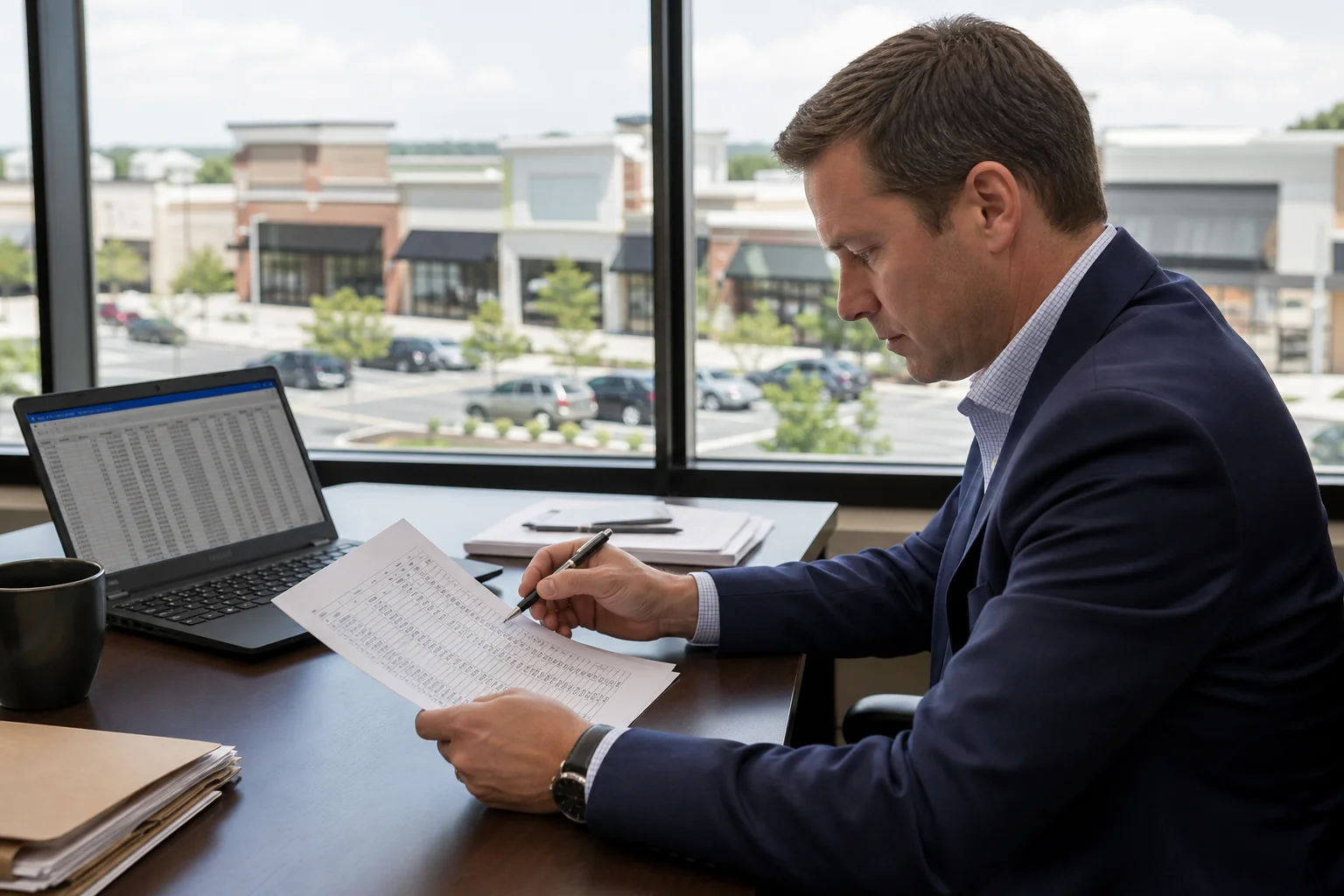
How CAM Reconciliation Works and What a Mesa Retail Tenant Should Audit Before Signing Off
A reconciliation statement is not self-verifying. Tenants who accept the numbers without review routinely overpay, sometimes for years, because errors compound each time a new budget is built on the prior year's inflated actuals. Understanding how CAM reconciliation works and what a Mesa retail tenant should audit helps protect your bottom line every lease year, and the review does not require an accounting degree, just a checklist and the text of the lease in hand.
Review the CAM Reconciliation Statement Line by Line
Request the full backup detail, not just the summary total. Compare each line item against the categories the lease actually defines as recoverable. Landlords occasionally bill costs that belong to their own operations rather than the shared property, and those charges should never reach a tenant's cam reconciliation. Many landlords can provide this documentation online through a tenant portal, and it is worth asking for supporting invoices on any line item above a few thousand dollars.
Compare Estimated Payments to Actual Charges
Pull twelve months of estimated payment records and match them against the final statement. A gap that consistently favors the landlord, quarter after quarter, is worth flagging even if each individual variance looks small on its own, since small variances add up across a multi-year lease term.
Flag Capital Expenses Billed as CAM Charges
Roof replacement, parking lot repaving beyond routine sealcoating, and major HVAC replacement are capital expenditures in most leases, not operating expenses. A well-drafted lease amortizes these over their useful life rather than passing the full cost through in one year's cam charges. If a statement shows a large one-time capital item folded into CAM, that is the single most common overcharge tenants find, and it is worth a direct conversation with the landlord before payment is due.
Audit Rights and Lease Terms Every Tenant Should Confirm
Audit rights give a tenant the contractual ability to inspect the landlord's books and records behind a CAM reconciliation statement, typically through an independent accountant, within a defined window after the statement is delivered. Without an audit rights clause negotiated into the lease terms up front, a tenant has little leverage to challenge charges after the fact, no matter how clear the error looks.
Before signing a retail lease, tenants and their brokers should try to confirm four things: the length of the audit window, whether the landlord caps controllable CAM charges (items like management fees and landscaping that the landlord controls, as opposed to property taxes or insurance that the landlord does not), whether a gross-up provision applies when the property is not fully occupied, and what documentation the landlord is required to produce on request. A cap on controllable charges, often a modest annual growth limit, keeps CAM increases predictable even when other costs move independently. Confirming these points before signing is best practice for any Mesa retail tenant.
Tenants who negotiate these terms up front save significant money and avoid disputes later, and it is generally easier to secure favorable audit rights during lease negotiation than to add them after the lease is signed. Good representation on this point often pays for itself well before the first CAM reconciliation lands.
Frequently Asked Questions
What is CAM reconciliation in a retail lease? CAM reconciliation is the annual process where a landlord compares the estimated common area maintenance payments a tenant made during the year to the property's actual operating expenses, then bills the tenant for any shortfall or issues a credit for any overpayment based on the tenant's pro-rata share.
How is a tenant's pro-rata share calculated? Pro-rata share is generally the tenant's leased square footage divided by the total leasable square footage of the retail property, though the exact denominator method varies by lease. That ratio is applied to CAM charges, operating expenses, property taxes, and insurance to determine what each tenant owes for the year.
What can a Mesa retail tenant dispute in a CAM reconciliation statement? A tenant can typically dispute capital expenses billed as operating costs, math errors in the pro-rata share calculation, charges outside the categories defined in the lease terms, and any costs that exceed a negotiated cap on controllable CAM charges, assuming the lease's audit rights clause is exercised within the required window.
Do all retail leases in Mesa include audit rights? No. Audit rights are negotiated, not automatic. Some landlord-drafted leases omit them entirely or limit them to a short window with narrow scope. Tenants should confirm audit rights are included and reasonable before signing, since this clause is what gives a CAM reconciliation dispute any real leverage.
Get a CAM Reconciliation Review From Pierce Commercial Real Estate
If your Mesa retail lease is up for renewal or you are underwriting a new location, our team can review the CAM reconciliation history before you sign. Contact our brokerage to schedule a lease terms review.