


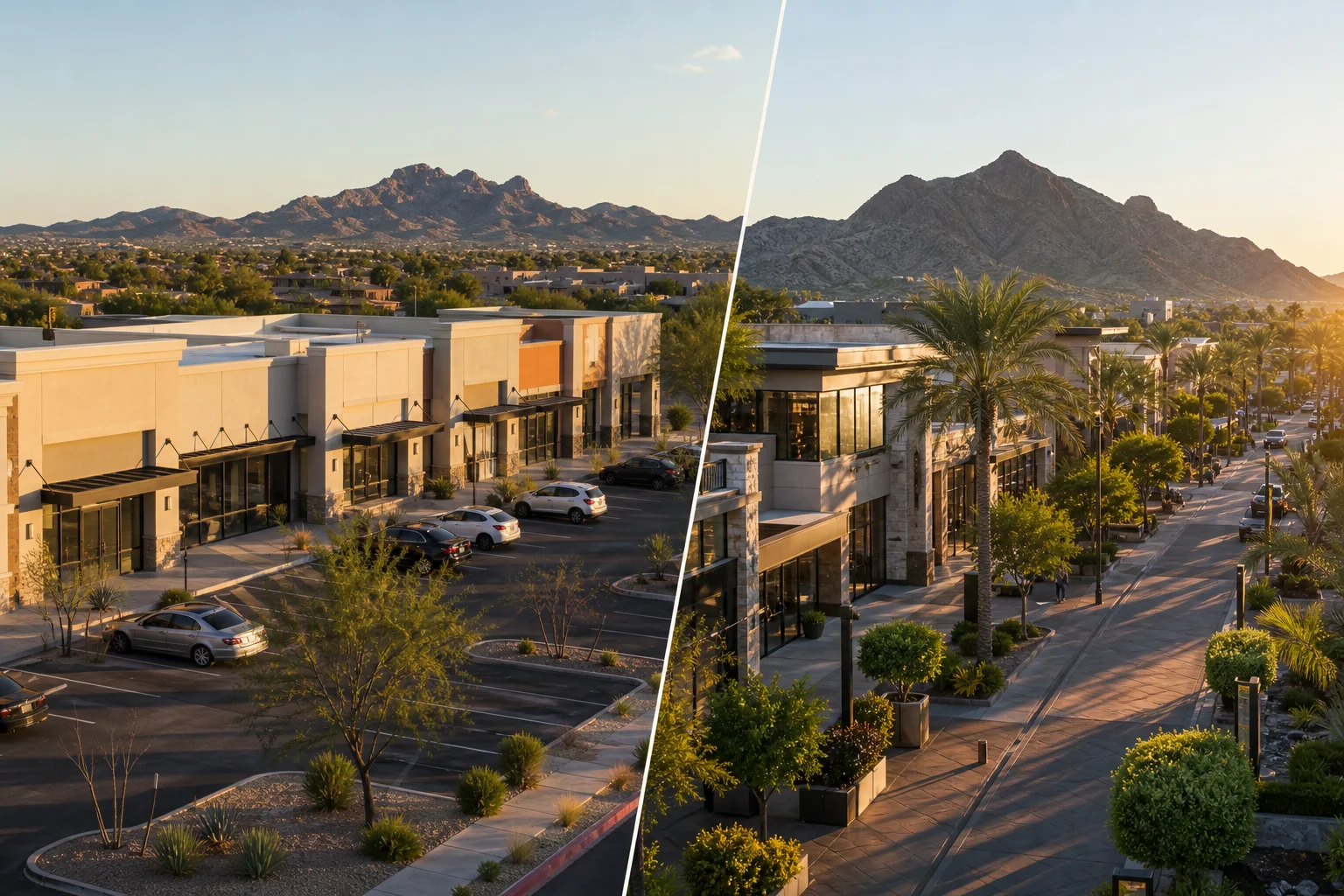
Gilbert or Scottsdale for a small retail investment comes down to two questions that matter more than today's list price: how deep is the tenant pool, and who buys the asset when you're ready to sell. Gilbert offers a lower entry basis and steady rooftop growth; Scottsdale commands a premium for retail leasing exposure in an established, affluent trade area.
By David Pierce, MHG Commercial
Weighing Gilbert or Scottsdale for a Small Retail Investment Right Now
For most buyers weighing Gilbert or Scottsdale for a small retail investment, both markets check the box on population growth and household income. Gilbert has added rooftops steadily across the East Valley for two decades, feeding retail demand along Gilbert Road, Val Vista, and the Santan corridor. Scottsdale's retail real estate sits inside a more mature, higher-income trade area with less land left to build on, part of why buyers pay a premium for it.
Both cities support a strong sense of community, from downtown Gilbert's Heritage District events to Old Town Scottsdale's art walks and festivals. Downtown Gilbert's dining scene, anchored by long-running draws like Joe's Farm Grill, gives small retail tenants foot traffic that newer corridors don't have yet. Both cities also sit within a reasonable drive of Phoenix Sky Harbor International Airport, which matters to out-of-state buyers evaluating either market without a long site visit. What community events and rooftop growth don't tell you is what it actually costs to own the real estate people are showing up to, and that's where the two markets start to diverge.
Tenant Depth in Gilbert and Scottsdale Retail Corridors
Tenant depth is the number of qualified, well-capitalized operators competing for space in a given trade area, and it's the single best predictor of how fast you re-lease a vacancy and at what rent. A market with deep tenant demand backfills a dark unit in months; a shallow one leaves it dark for a year while carrying costs eat into the return you underwrote.
Gilbert's tenant pool skews toward regional and national quick-service restaurants, medical and dental users, personal service concepts, and fitness operators chasing rooftops in newer master-planned communities. That demand is broad but price-sensitive: these tenants know their options and negotiate hard on tenant improvement dollars. Scottsdale draws a narrower but often stronger set of boutique, hospitality-adjacent, and luxury service tenants willing to pay premium rent for foot traffic and brand positioning, but fewer of them chase any given vacancy outside the core tourist corridors. For a small retail investment, that trade-off is the whole ballgame: Gilbert gives you more shots on goal to fill a space, while Scottsdale gives you fewer, better-paying shots.
Exit Buyer Pools: Who Buys Small Retail When It's Time to Sell
When it's time to sell, the buyer pool for a small retail asset splits roughly into three groups: local private investors trading up from a smaller holding, out-of-state capital chasing Arizona's growth story, and 1031 exchange buyers working against a tight replacement-property deadline. Gilbert's growth narrative, rooftops, school quality, and business relocations, plays well with the first two groups, who are underwriting the story more than the trophy address. Many of those exchange buyers are 1031 exchange services clients moving fast against a 45-day identification window, and a well-leased small center in a growth corridor is exactly the kind of asset they can close on quickly.
Scottsdale's exit pool leans more toward buyers who want the address itself: family offices, high-net-worth individuals, and 1031 buyers specifically seeking a trophy or near-trophy location they intend to hold long term. That pool is smaller but often less price-sensitive on a well-located asset. Gilbert tends to sell on numbers and growth trajectory; Scottsdale tends to sell on scarcity and prestige. A broker underwriting your exit needs to know which story your asset is actually telling.
Cap Rates for Small Retail Deals in Gilbert and Scottsdale
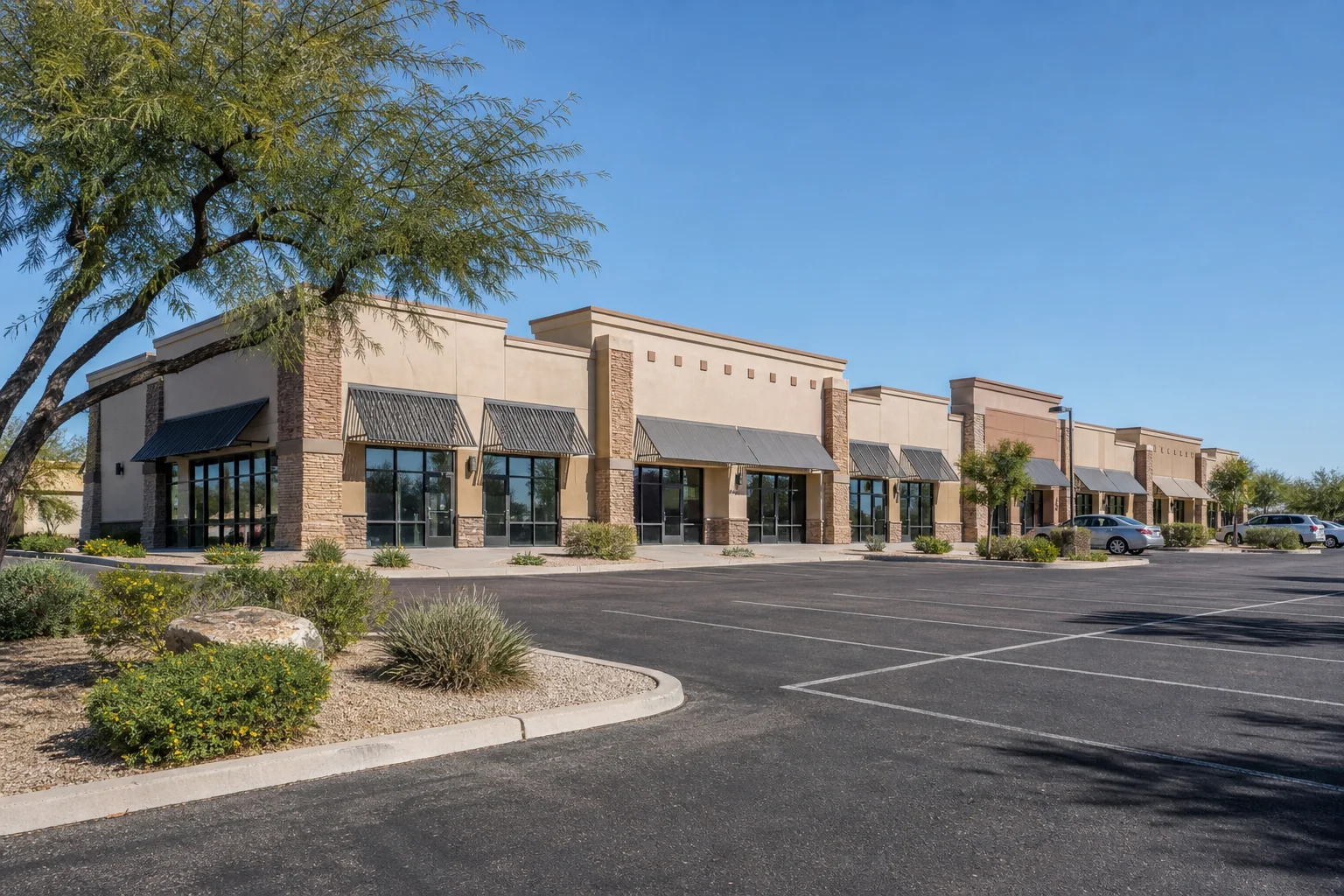
Cap rates on small retail deals move with basis risk and buyer competition, not just location prestige, and Gilbert and Scottsdale sit on opposite ends of that spectrum. Scottsdale retail has historically traded at tighter cap rates than Gilbert on comparable lease terms, because the buyer pool competing for that address accepts a lower going-in yield for the perceived durability of the location. Gilbert typically prices at a wider cap rate for a similar credit tenant and lease structure, reflecting the market's shorter track record and the fact that buyers are underwriting future rent growth rather than a proven trophy corridor.
Neither number is fixed, and quoting a specific rate without seeing the actual rent roll, lease term remaining, and tenant credit would be misleading. Directionally: if you need the strongest possible going-in yield on day one, Gilbert usually gets you there faster. If you're underwriting a long hold and betting on rent growth compounding over time, Scottsdale's tighter entry cap rate can still make sense.
Price Per Square Foot: Gilbert Versus Scottsdale Retail
Price per square foot follows the same logic as cap rate, expressed differently. Scottsdale retail real estate commands a meaningfully higher price per square foot than comparable Gilbert product, driven by land scarcity, higher household incomes in the immediate trade area, and a deeper base of institutional and high-net-worth capital competing for anything that comes to market. That premium is real, but it isn't automatically too expensive for a small investor; it depends on how much of that premium is supported by achievable rents versus how much is paid for the address itself.
Gilbert gives a first-time or small-check buyer more square footage, and often a stronger going-in yield, for the same investment dollars. The honest way to frame the choice isn't expensive versus cheap, it's what you're actually buying with the premium. In Scottsdale, part of what you're paying for is a shallower future vacancy risk in a supply-constrained market. In Gilbert, part of what you're saving shows up later as more competition when you go to re-lease.
Risk and Fit for a First Small Retail Investment
Framed as Gilbert or Scottsdale for a small retail investment, risk shows up less at the metro level and more in the specific corridor, tenant mix, and lease structure you actually buy into. A well-located, well-leased small center in Gilbert and a thinly-leased center in Scottsdale are not equivalent bets just because one city carries a stronger reputation.
That said, for a first-time buyer with a smaller check and less tolerance for a long lease-up if a tenant vacates, Gilbert's broader tenant depth usually means an easier re-lease and a shorter runway back to full occupancy. Scottsdale can work for a first deal too, but it typically rewards a buyer who already has relationships with the boutique and hospitality-adjacent tenants that dominate its trade areas, or who is comfortable carrying a vacancy longer while the right tenant is found. Neither market removes execution risk: buying the wrong lease structure or corridor in Gilbert can underperform a well-bought Scottsdale asset, and the reverse is just as true.
Frequently Asked Questions
Is Gilbert or Scottsdale better for a first-time retail investor? For most first-time buyers, Gilbert's broader tenant depth and lower entry basis make execution easier: a vacancy typically re-leases faster and the downside if a tenant fails is smaller. Scottsdale can work well for a first deal too, but it usually rewards a buyer with existing relationships among boutique or hospitality tenants, or one comfortable carrying a longer lease-up for a stronger address.
What cap rate is realistic for a small retail property in Gilbert compared to Scottsdale? There's no single number we'd quote without underwriting the actual rent roll, lease term, and tenant credit. Directionally, Scottsdale retail has historically traded at tighter cap rates than Gilbert on comparable lease terms, reflecting buyer demand for the address. Gilbert typically prices at a somewhat wider cap rate, reflecting a shorter track record and more reliance on future rent growth.
Is Scottsdale retail real estate too expensive for a small investor compared to Gilbert? Scottsdale commands a real premium per square foot over comparable Gilbert product, but that doesn't automatically make it a bad buy; it depends on whether achievable rents support the price paid. A small investor typically gets more square footage and often a stronger going-in yield per dollar in Gilbert, while Scottsdale trades some of that day-one yield for lower future vacancy risk in a supply-constrained market.
Why do Gilbert's school ratings matter to a retail investor? School quality is a leading indicator of rooftop growth, and rooftop growth feeds tenant demand. Higley Unified School District consistently earns strong academic ratings, and Gilbert Public Schools follows a similar track record. Together they draw families who support the quick-service, medical, personal-service, and fitness tenants that fill small retail centers along Gilbert's growth corridors. Strong schools don't guarantee a lease-up, but they support the demand story.
What counts as a small retail investment in the Phoenix metro area? There's no single cutoff, but in practice a small retail investment usually means a single-tenant pad, a small multi-tenant strip, or a neighborhood center that a private investor or 1031 buyer can acquire without institutional-scale capital. Across the Phoenix metro area, that puts a small retail deal well below the size of a major power center or regional mall, and squarely within reach of a first-time or growing commercial buyer.
Talk to MHG Commercial About Your Next Small Retail Deal
Gilbert or Scottsdale for a small retail investment isn't a question with one universal answer. It depends on how much basis risk you're willing to carry now against the exit story you're underwriting. Contact our brokerage to walk through the specific corridor, tenant mix, and lease structure behind any property you're evaluating.