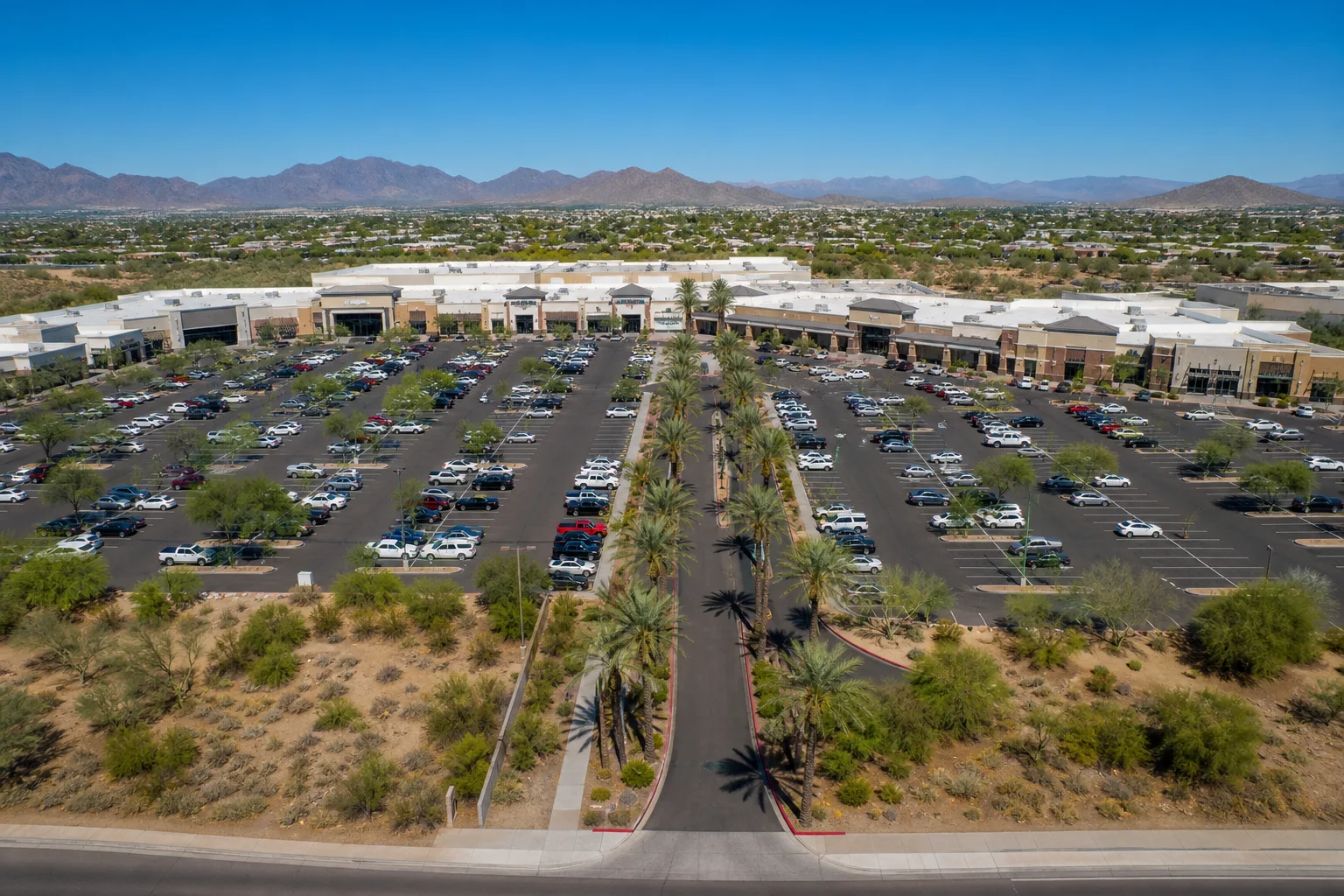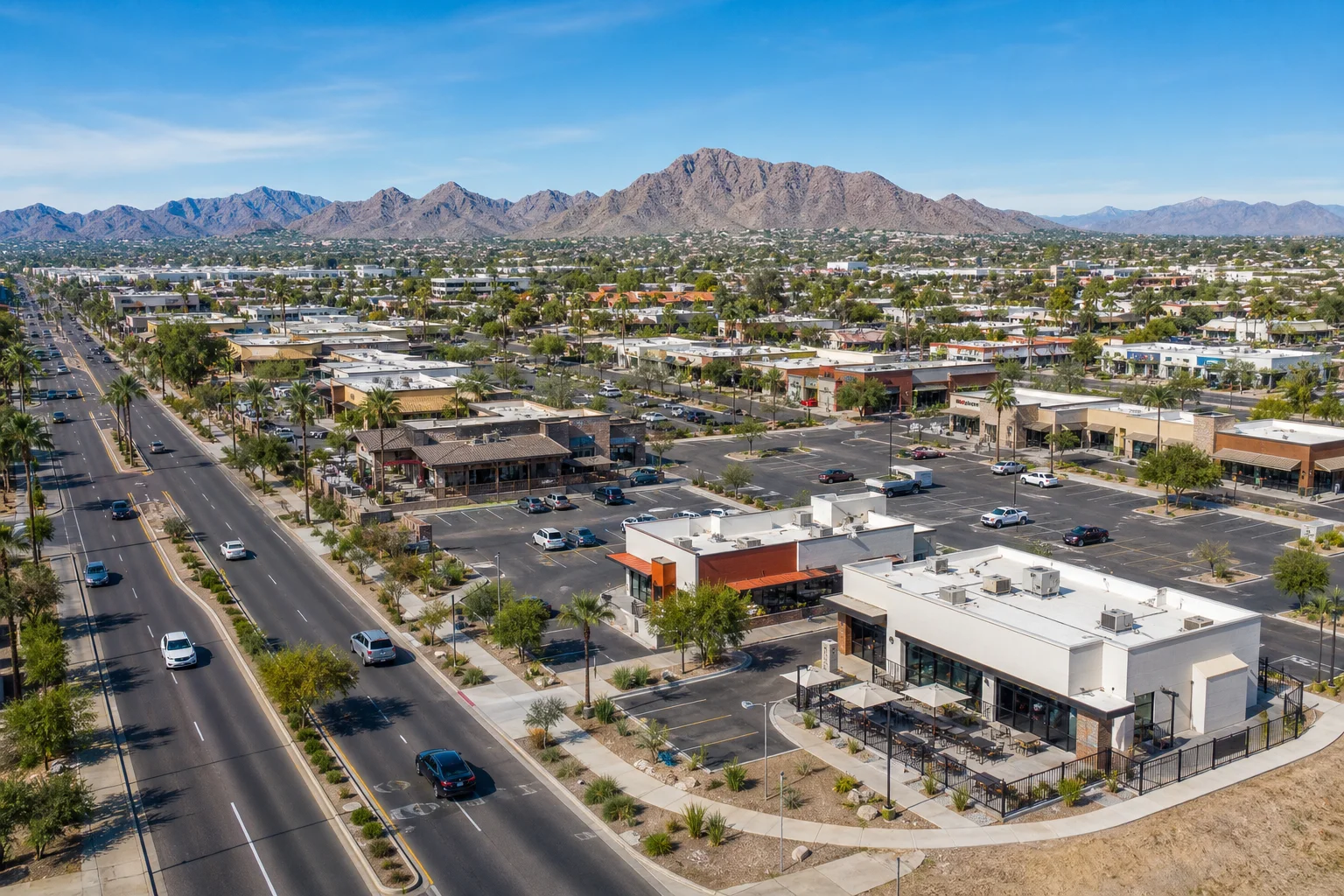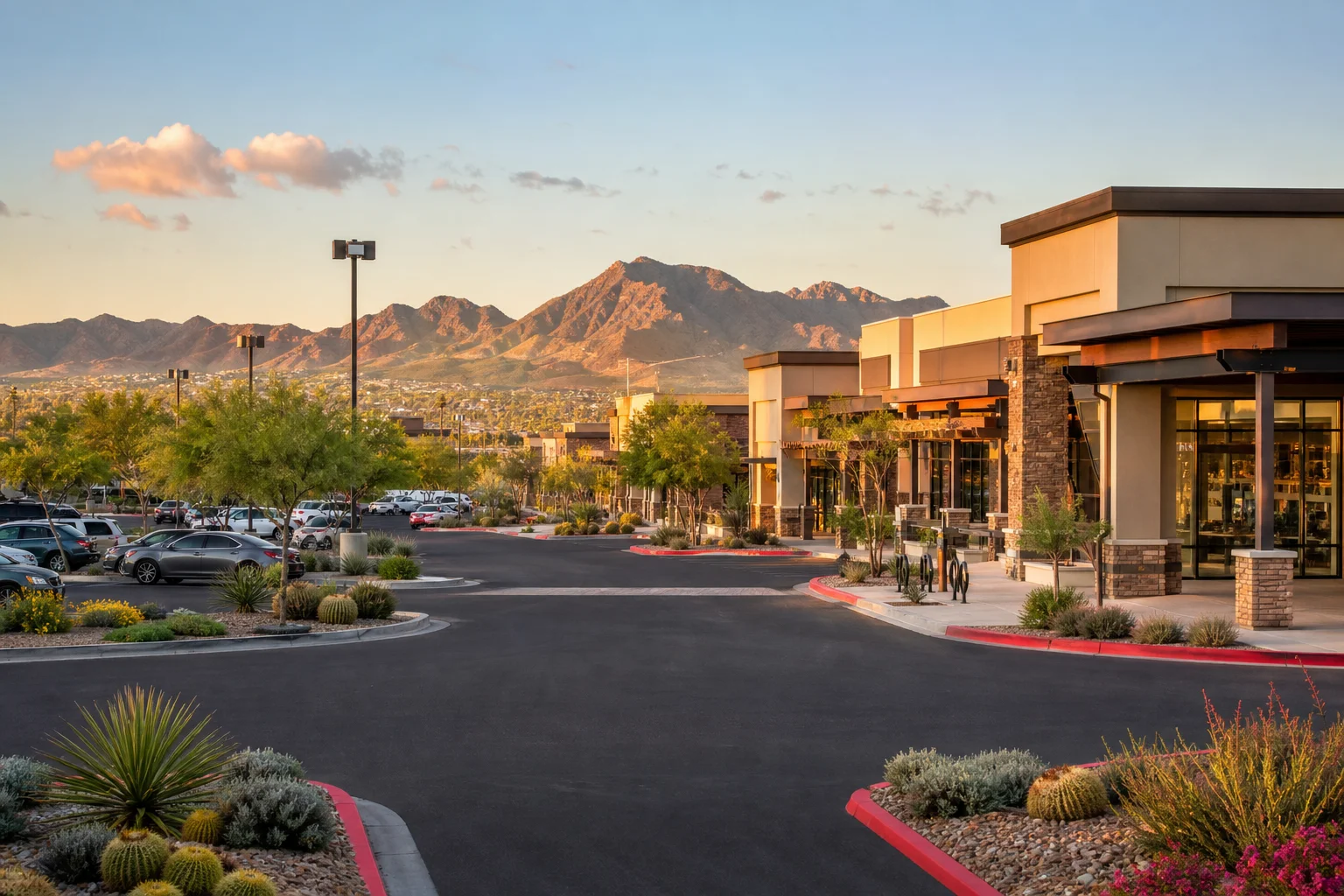
Understanding how to evaluate retail lease terms in Chandler, Tempe, and Gilbert starts with five core variables: base rent structure, expense reimbursements, lease length, renewal mechanics, and landlord concessions. Each clause directly affects your monthly occupancy cost and long-term financial flexibility in one of Arizona's most competitive East Valley retail markets.
By David Pierce, MHG Commercial
Retail Lease Structure Types in the East Valley
Most retail commercial real estate in Chandler, Tempe, and Gilbert trades on a triple net (NNN) basis. Under a NNN lease, tenants pay base rent plus a pro-rata share of property taxes, insurance, and common area maintenance (CAM). A gross lease bundles all operating expenses into one flat monthly payment. Modified gross leases fall between the two and appear in older retail centers where landlords blend cost allocation across expense categories.
Understanding which structure applies is the first step in any lease evaluation. A space listed at $28 per square foot NNN in Chandler may carry $8 to $12 per square foot in additional NNN charges depending on property age, management overhead, and the parcel's current tax assessment. The quoted base rent and the full NNN load together represent your true monthly occupancy cost, not the rent line alone.
Always request two to three years of actual operating expense history before comparing locations across the Phoenix East Valley. This baseline research is central to how to evaluate retail lease terms in Chandler, Tempe, and Gilbert with real numbers rather than asking prices.
Taxes, Insurance, and CAM: What You Are Really Paying Each Month
The taxes insurance and CAM charges in a commercial lease proposal are estimates, not guaranteed amounts. Landlords calculate an annual budget for these operating costs, divide by total leasable square footage in the center, and bill tenants monthly as part of the NNN obligation. At year end, actual expenses are reconciled against the monthly estimates. If actuals exceed the projected total, tenants owe the shortfall. If actuals come in lower, tenants receive a credit.
Reviewing three years of prior reconciliation statements before signing reveals whether the landlord has been accurate or aggressive in expense projections. Look for a CAM cap clause on controllable expenses, typically a 3 to 5 percent annual increase limit, so your occupancy budget remains predictable from year to year. Centers that do not offer a CAM cap expose tenants to unconstrained growth in taxes, insurance, and maintenance costs as the property ages or ownership changes.
Chandler and Gilbert properties generally carry lower property tax assessments per square foot than comparable Tempe locations, particularly those near Arizona State University's urban core where assessed values run higher. Quantifying that difference matters when evaluating retail options across all three submarkets, especially for longer lease terms where tax assessments may rise with the market.
Lease Term Length and Renewal Options in the East Valley
Lease term selection is a strategic financial and operational decision. Short terms of 3 years offer exit flexibility but typically come with smaller tenant improvement allowances and higher asking rents. Longer terms of 5 to 10 years allow tenants to lock in current market rent and negotiate more substantial landlord concessions at lease commencement.
East Valley retail vacancy has tightened considerably, with inline retail availability in well-trafficked Chandler and Gilbert corridors remaining historically low, according to market tracking from CBRE's Phoenix Retail MarketView research, 2025. That supply constraint gives landlords real leverage over lease term length, which is why understanding your competing alternatives before any lease negotiation begins is critical to getting favorable terms.
Renewal option language deserves careful review. A "fair market value" renewal clause provides occupancy security but no rent certainty at renewal time. A fixed-increase option, for example 10 percent per option period, allows reliable forecasting over a multi-year horizon. For retail businesses where location is a core operational asset, predictable renewal economics matter as much as the initial lease term itself.

Tenant Improvement Allowances and Lease Negotiation Strategy
Tenant improvement allowances (TIA) are among the most financially significant variables in a retail lease. A landlord offering $40 per square foot on a 3,000-square-foot space contributes $120,000 toward your buildout, reducing upfront capital deployment and improving the overall financial position of the deal. TIA levels vary considerably across the East Valley based on property quality, landlord capital position, and how competitive the center is for tenants.
In high-demand corridors like the Price Road corridor in Chandler or the Santan Village zone in Gilbert, TIA levels have compressed as vacancy tightens. Spaces in secondary locations or older vintage centers typically offer more generous allowances to attract creditworthy tenants. Before accepting any TIA offer, confirm what scope of work it covers, whether funds flow through the landlord or directly to your contractor, the disbursement timeline, and whether unused allowance is forfeited or can be applied to rent.
Effective lease negotiation in Chandler, Tempe, and Gilbert means knowing where landlords have room to move. Base rent is negotiable in centers carrying multiple vacancies. CAM caps, free rent periods, co-tenancy clauses, and exclusivity provisions are all legitimate points to raise. Free rent is one of the most common concessions: a landlord might offer two to four months rent-free at commencement in exchange for a longer commitment. On a 2,500-square-foot space at $30 NNN per square foot, three months of free rent represents $18,750 in direct savings that should factor into your full lease comparison.
How to Evaluate Retail Lease Terms Before You Commit Capital
No real estate commitment should rest on per-square-foot rent alone. Build a complete occupancy cost model that includes base rent, estimated NNN charges, any TIA repayment obligations if the allowance is structured as a loan rather than a grant, buildout costs above the allowance, and any percentage rent provisions in the commercial lease.
Percentage rent clauses require tenants to pay additional rent once revenue crosses a defined breakpoint. A lease might specify 6 percent of gross sales above $600,000 annually. Modeling projected revenue against that threshold shows what exposure looks like in a strong sales year and whether the clause materially affects profitability over the lease term.
For investors evaluating leased retail assets in Chandler, Tempe, or Gilbert, the same discipline applies at the portfolio level. Lease term staggering, tenant credit quality, expense reimbursement structure, and remaining lease term all affect income stability and the asset's market value when it eventually trades. The complete picture of how to evaluate retail lease terms in Chandler, Tempe, and Gilbert requires both a detailed financial model and an honest read of local submarket conditions, including rent trends, vacancy movements, and new supply coming online.
Frequently Asked Questions
What is the difference between a gross lease and a NNN lease in retail real estate?
A gross commercial lease covers all operating expenses in one flat monthly rate paid by the tenant. A triple net (NNN) lease requires tenants to pay base rent plus their proportionate share of property taxes, insurance, and CAM charges. Most retail commercial real estate in Chandler, Tempe, and Gilbert is leased on a NNN basis, meaning the quoted rent per square foot is not the total monthly occupancy cost.
How long are typical retail lease terms in the Phoenix East Valley?
Most retail lease terms in the Phoenix metro run between 3 and 10 years. Smaller inline spaces typically require 3 to 5 year initial commitments. Larger spaces requiring significant landlord buildout investment tend to carry 7 to 10 year lease terms, often with one or two renewal option periods of 3 to 5 years negotiated alongside the base lease term.
Can tenants negotiate free rent in the current East Valley retail market?
Free rent remains a standard concession in retail leasing. Centers with multiple vacancies offer more flexibility, where 2 to 4 months at commencement is a reasonable request. In lower-vacancy Chandler and Gilbert corridors, shorter periods of 1 to 2 months are more typical, though the full lease negotiation package, including TIA, CAM caps, and renewal terms, determines the overall economic outcome.
What should I review in a CAM reconciliation before signing a commercial lease?
Request actual reconciliation statements from the prior two to three years and compare them against the monthly estimated charges. Look for large year-over-year swings, the management fee percentage included in CAM, and whether controllable expenses are capped. A lease without a CAM cap exposes tenants to unconstrained cost growth tied to taxes, insurance, and maintenance decisions made by the landlord without tenant input.
How do leasing conditions differ across Chandler, Tempe, and Gilbert?
Tempe, particularly near Arizona State University, carries tight retail vacancy and less landlord flexibility on terms and concessions. Chandler and Gilbert offer more inventory across suburban power centers and newer developments, which generally gives tenants more leverage on lease term length, TIA amounts, and free rent during lease negotiation. Expense structures and tax assessments also differ meaningfully across the three submarkets.
Connect With Pierce CRE for East Valley Retail Leasing
Retail commercial real estate decisions carry multi-year financial and operational consequences that require local-market expertise and detailed lease analysis. Contact our brokerage to review retail lease options across Chandler, Tempe, and Gilbert with a broker who works these submarkets every day.