


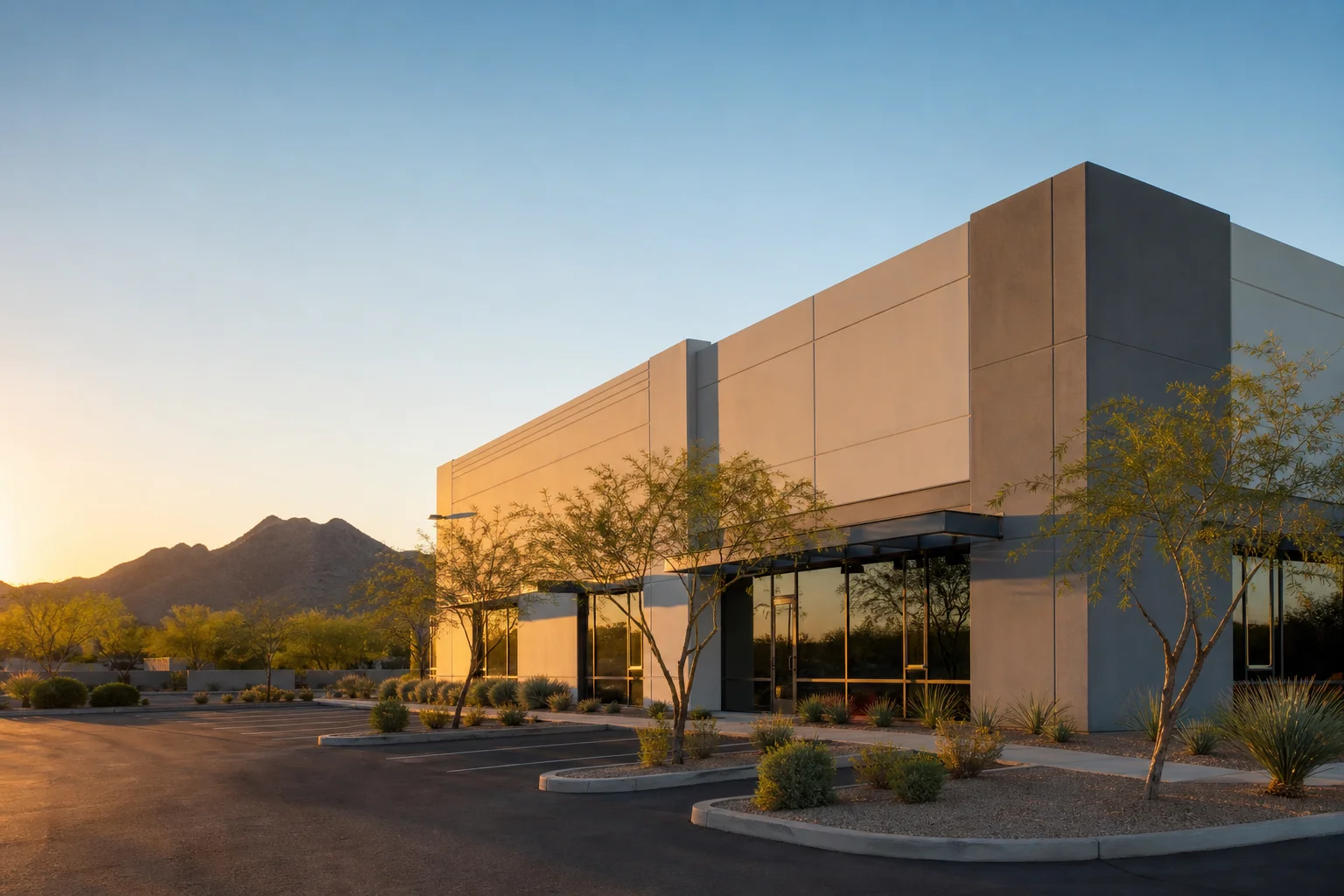
Deciding lease vs buy for a growing Phoenix business starts with total occupancy cost, not the monthly number on a term sheet. Whether you're weighing office space versus a purchase, the real comparison spans cash flow, tax benefits, lease term, and the equity ownership builds over time.
By David Pierce, MHG Commercial
What the Lease vs Buy for a Growing Phoenix Business Decision Really Compares
Most owners frame the lease vs buy for a growing Phoenix business question as a rent check versus a mortgage payment. That comparison misses most of the picture. A total occupancy cost model adds up everything a location actually costs across the full lease term or loan term: base rent or debt service, property taxes, insurance, maintenance, repairs, tenant improvements, and the capital tied up in a down payment instead of working in the business. Two buildings with identical square footage and asking price can carry very different total cost profiles once operating expenses, common area maintenance, and financing terms are factored in.
The key difference between leasing and buying is who absorbs the risk of change. The total cost comparison also has to account for what growth does to a lease or a mortgage. A business that doubles headcount in three years needs different things from its real estate than one holding flat. Leasing keeps options open when goals and space requirements are still moving targets. Ownership locks in a location and a cost basis, which pays off if the business plan holds and burns capital if it does not. Neither leasing nor buying is automatically the best answer, the right choice depends on how confident you are in your five-year footprint.
Cash Flow and Monthly Payments Come First
For most growing companies, cash flow is the first filter, before tax benefits or long-term equity enter the conversation. Leasing space, whether that's retail leasing storefronts along a Chandler or Gilbert corridor or a warehouse bay in an industrial park, generally requires less cash at signing than a purchase. A security deposit and prorated rent are a fraction of the down payment, closing costs, and reserve requirements a lender expects on an owner-occupied purchase. That difference in lower upfront costs matters most to businesses that need capital for inventory, staffing, or equipment rather than real estate.
Monthly payments tell a similar story in the short run. Lease payments are typically lower than the monthly payments on a comparable purchase once you include principal, interest, taxes, insurance, and a maintenance reserve. That gap narrows over a longer lease term as rent escalations compound, and it can reverse entirely if a business signs a long-term ownership position while interest rates are favorable. Every leasing buying decision should run both monthly numbers side by side for year one, year five, and year ten, not just the number on the signing page.
Tax Benefits, Tax Advantages, and Total Cost Over a Full Lease Term
Tax benefits cut differently depending on which side of the lease vs buy line a business sits on. Lease payments are generally fully deductible as a business operating expense, which simplifies the tax picture and keeps more of the deduction available in early, cash-tight years. Ownership carries its own tax advantages: depreciation, mortgage interest deductions, and the ability to control the asset for a future 1031 exchange when the business outgrows the building. A CPA should model both scenarios against actual income projections, since the tax advantages of ownership depend on individual tax positions in a way rent deductions do not.

Total cost only tells the full story once taxes are layered back in. A lease that looks more expensive month to month can still win on total cost if the deduction timing and lack of maintenance reserve responsibility offset the higher rent. A purchase that looks cheaper on a monthly payment basis can lose ground once property tax increases, major system replacements, and vacancy risk during a future sale are added to the ledger.
Lease Payments, Business Lease Structures, and What They Cost You
Not every business lease is priced the same way, and the structure changes what lease payments actually buy. A triple net business lease pushes property taxes, insurance, and maintenance onto the tenant, which lowers the base rent but adds cost volatility a gross lease would have absorbed. A modified gross business lease splits some of those costs, landing between the two. Before signing, a growing company should map its five-year growth goals against the lease term: a short lease term preserves flexibility to relocate as space needs change, while a longer lease term can lock in favorable lease payments before Phoenix rents climb further.
Industrial tenants face a version of this same tradeoff on a larger scale. A distribution or light-manufacturing operation evaluating industrial space has to weigh clear height, dock door count, and power capacity against lease term length, since specialized buildouts rarely transfer cleanly to a new space if the lease term ends before the equipment does. A shorter lease term can allow a growing business to relocate quickly if space needs change again.
When Ownership Fits Your Business Needs Better Than a Lease
Ownership tends to fit business needs best when three conditions line up: the business has enough capital to cover a down payment without starving operations, the space requirement is stable enough to commit to for seven to ten years or more, and the location itself is a long-term asset, not just a place to operate. Owning gives a business control over signage, buildout, subleasing, and timing that a landlord otherwise governs through lease clauses. It also converts a monthly payment into equity instead of a sunk cost, which matters for owners planning an eventual sale or a longer-term real estate position built around ownership rather than rent.
Ownership is not free of risk. Vacancy, a slower resale market, or a major repair on an aging roof or HVAC system falls entirely on the owner, not a landlord. Businesses that value flexibility over control, or whose growth trajectory is still uncertain, are often better served leasing until the business needs stabilize enough to justify a purchase.
Frequently Asked Questions
Is leasing or buying better for a small, growing business in Phoenix? It depends on capital position and growth certainty. Leasing preserves cash flow and flexibility for businesses still scaling their space requirements. Buying fits businesses with stable, predictable growth and enough capital to absorb a down payment, maintenance, and market risk in exchange for building equity and long-term control.
How do I calculate total occupancy cost instead of just comparing rent to a mortgage payment? Add base rent or debt service, property taxes, insurance, maintenance, repairs, and tenant improvement costs across the full lease term or loan term, then subtract any tax benefits. Compare that total cost, not the monthly payment alone, across a five-to-ten-year hold to see which option actually costs less.
Do lease payments or mortgage payments offer better tax advantages? Lease payments are typically fully deductible as an operating expense. Ownership offers different tax advantages, including depreciation and mortgage interest deductions, along with future 1031 exchange eligibility. The better answer depends on a business's specific income and tax position, which a CPA should model before signing either.
What lease term should a growing business negotiate? A shorter lease term preserves flexibility if space needs are likely to change within a few years. A longer lease term can lock in current lease payments before rents rise, but it reduces flexibility if the business outgrows or downsizes the space sooner than expected.
When does owning commercial property make more sense than a business lease? Ownership tends to make sense once a business has stable, predictable space needs for seven or more years and enough capital to cover a down payment without disrupting operations. Until then, a business lease usually protects cash flow and flexibility better than a purchase.
Talk to a Phoenix Broker Before You Sign or Buy
The right answer to lease vs buy for a growing Phoenix business depends on numbers specific to your industry, capital position, and growth timeline, not a general rule. Contact our brokerage to run the total occupancy cost model against your actual lease or purchase options.