


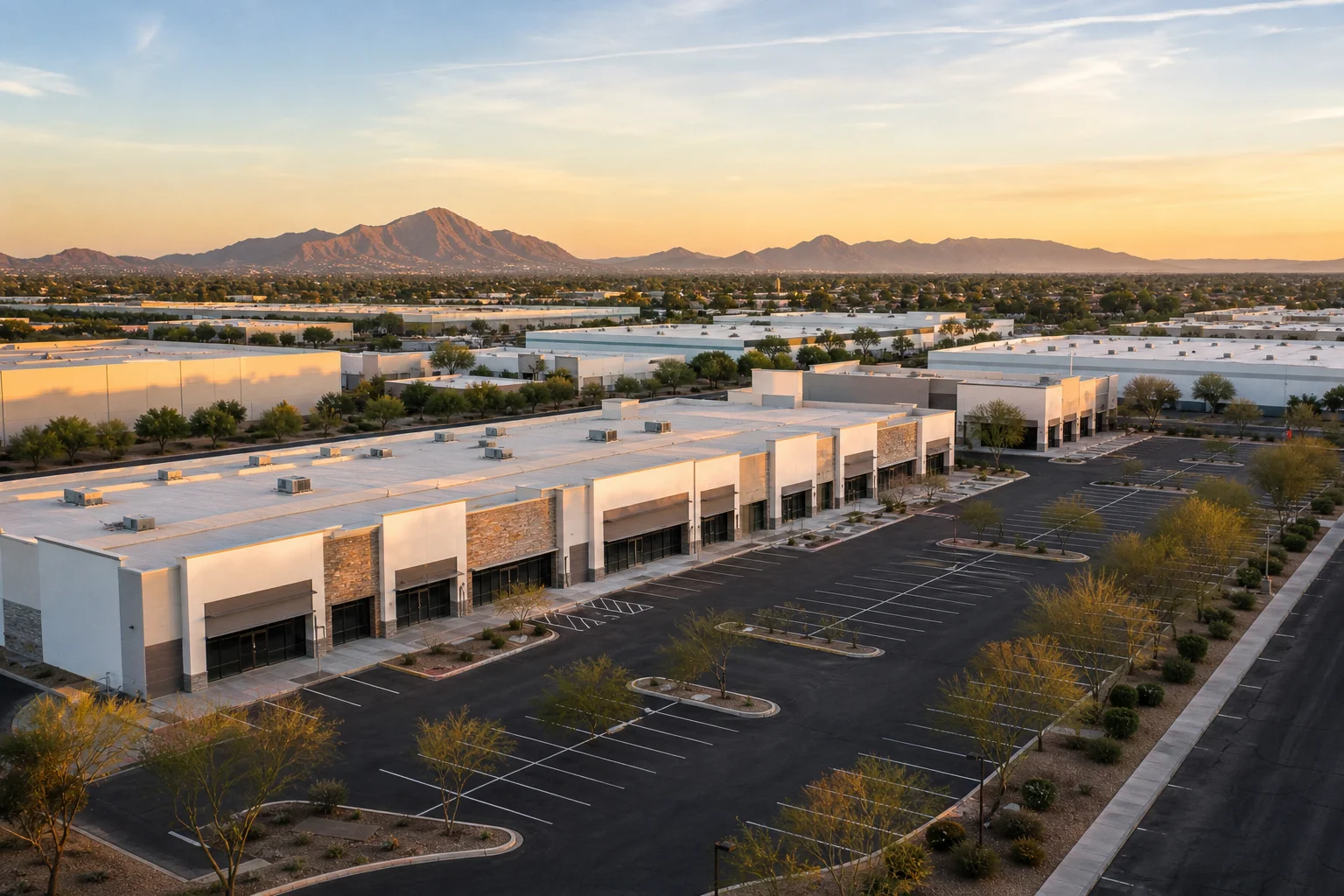
Once a Phoenix-metro property is stabilized, the sell, refinance, or hold decision determines whether an owner locks in gains, redeploys capital, or lets the asset keep compounding value. The right call depends on interest rates, loan term, and where the current cycle sits inside your broader investment portfolios, not on habit.
By David Pierce, MHG Commercial
Where the Phoenix Industrial and Retail Cycle Stands Right Now
Chandler, Tempe, Gilbert, and Scottsdale have moved through a full leasing cycle since 2021: compressed vacancy, aggressive rent growth, then a slower, more selective phase as new supply came online. For owners of a stabilized retail center or industrial building, that shift changes the math behind every exit or hold strategy. A property that looked like an easy sale in a seller's market now competes with more inventory and pickier buyers, while the same asset held through the cycle may be generating stronger net operating income than it did at acquisition.
This is the environment where the sell, refinance, or hold question actually gets decided, not in the abstract, but against real absorption data, real cap rate movement, and a real debt market. Buyers today underwrite conservatively. Lenders scrutinize debt service coverage more closely than they did three years ago. An owner weighing a decision has to read those signals correctly before choosing a direction.
Investors who manage a single stabilized asset alongside a broader plan should treat each property on its own numbers. The best deal available today may be no deal at all: simply continuing to manage the asset for cash flow while the market resets.
The Sell, Refinance, or Hold Decision Tree
Every stabilized commercial asset eventually reaches a decision point, and the sell, refinance, or hold framework gives owners a structured way to work through it rather than reacting to the first offer or the first rate quote that comes in. Three questions drive the analysis:
- Does the asset still fit the strategy? A retail center bought for cash flow and a land parcel held for appreciation get evaluated differently.
- Is there more value trapped in the asset than the current debt reflects? That gap is what a refinance is built to capture.
- Would selling now beat holding through the next leasing cycle, after tax and after closing costs?
None of these questions has a universal answer. A well-located industrial building in Chandler with several years left on its lease term supports a very different decision than a single-tenant retail pad approaching a vacancy. The framework only works when it is applied asset by asset, with current numbers, not assumptions carried over from the year the property was acquired.
Selling a Stabilized Asset: When the Numbers Say Go
Selling makes the most sense when an asset has reached, or is close to reaching, its highest achievable value for the current ownership structure, and further upside would require capital or risk the owner is not positioned to take on. That could mean a retail center is fully leased at market rent with no near-term renovation upside, or an industrial building sits in a submarket where buyer demand is unusually strong right now.
The selling home calculus and a commercial disposition run on the same core variables: payoff balance, closing costs, and net proceeds after debt is retired. On the commercial side, add depreciation recapture, potential 1031 exchange timelines, and broker and title costs into the underwriting before treating a headline sale price as the real return. An owner who nets less after those deductions than a refinance would have delivered in cash flow has not actually made the better decision by selling.
Sellers should also weigh how much of the gain is cycle-driven versus asset-driven. Value created by broad market appreciation across Chandler, Tempe, or Gilbert can compress again; value created by lease-up, renovation, or repositioning tends to hold.

Refinancing to Access Equity Without Losing the Asset
Refinancing lets an owner extract capital while keeping the asset and its future upside. It is the middle path in the sell, refinance, or hold decision, and it tends to make sense when the current interest rate environment still supports a loan term and monthly payment the property's income can carry comfortably.
The underlying math is closer to residential financing than most owners expect. Much like home equity in a personal residence, the equity built into a stabilized commercial property, through appreciation, principal paydown, or both, becomes accessible cash the moment a lender agrees to a new loan term. The property still has to service the resulting mortgage payments from operating income, so the analysis has to run a break even test: how many months of the rate improvement, or the extracted capital's return elsewhere, does it take to offset the closing costs and fees on the new loan.
Owners who assume interest rates will fall further sometimes delay a refinance that already pencils today. A disciplined refinance hold analysis compares the current monthly payments against a realistic range of near-term rate outcomes, not a hoped-for best case. For owners who would rather move equity into a new asset entirely without a taxable event, our 1031 exchange services team can walk through whether an exchange outperforms a straight refinance for a given asset and timeline.
Holding Through the Cycle: The Case for Staying Put
Holding is the right call when the asset's income is growing, the debt is well-structured, and selling or refinancing would only trade a strong long-term position for near-term liquidity the owner does not actually need. A well-leased industrial building in a supply-constrained Phoenix submarket, or a retail center with staggered lease expirations and built-in rent bumps, often falls into this category.
The case for holding usually comes down to opportunity cost. If the exit proceeds or refinance capital would not be redeployed into something that outperforms the asset's current cash flow and appreciation trajectory, holding preserves both. Owners should revisit this decision on a set schedule, annually at minimum, rather than letting it default to inertia. Market conditions, lease rollover, and debt maturity dates all shift the answer over time, and a hold decision made two years ago deserves a fresh look against where Chandler, Tempe, Gilbert, and Scottsdale sit today.
Owners weighing whether a broader mix of assets, rather than a single property, would better manage risk across a hold period should treat that hold decision the same way: on a schedule, with current numbers, not by default.
Frequently Asked Questions
How do I know if I should sell, refinance, or hold a stabilized commercial property? Start with three numbers: the asset's current market value against recent comparable sales, the rate and loan term available on a refinance today, and the property's cash flow if held unchanged. Selling wins when net proceeds beat the alternatives after closing costs and tax. Refinancing wins when the property can carry the new debt service. Holding wins when neither outperforms staying put.
Does refinancing a commercial property work like refinancing a home? The mechanics are similar. A lender reevaluates the asset's value, offers a new interest rate and loan term, and the owner receives cash if the new loan exceeds the payoff balance. The difference is underwriting: commercial lenders weigh the property's income and debt service coverage ratio rather than a borrower's personal monthly payments alone.
What costs should I expect when selling a stabilized asset? Budget for broker commission, title and escrow fees, any prepayment penalty on the existing loan, and, if applicable, depreciation recapture tax. Together these closing costs typically run several percentage points of sale price, which is why net proceeds, not the headline number, should drive the sell, refinance, or hold comparison.
How often should I revisit a hold decision on a Phoenix-metro asset? At least annually, and sooner if lease rollover, a loan maturity, or a meaningful shift in the local market changes the underlying numbers. A hold decision that made sense at acquisition can lose its edge as the cycle moves, so treat it as an ongoing evaluation rather than a one-time choice.
Get a Clear Read on Your Sell, Refinance, or Hold Decision
Every stabilized asset in the Phoenix market deserves a current, numbers-first look before an owner commits to a direction. Contact our brokerage to walk through the sell, refinance, or hold analysis for your property.