Housing a 10-person team in Tempe comes down to coworking vs. sublease vs. direct lease, three paths with different tradeoffs in cost, control, and commitment. Coworking moves fast, a sublease agreement can undercut market rent for a fixed term, and a direct lease locks in long-term stability. The right office space choice depends on what the business can afford.
By David Pierce, MHG Commercial
Coworking vs. Sublease vs. Direct Lease: What's the Real Difference?
Each option answers a different question about how much flexibility the business needs versus how much control it wants over the space itself.
Coworking Spaces
A coworking membership puts a team into a shared building with private suites or open desks, shared conference rooms, and month to month or short term commitments. The building operator handles furniture, internet, cleaning, and reception. A team gets access without negotiating a lease agreement or fronting capital for buildout.
Sublease Agreements
A sublease agreement lets a tenant occupy space that another business already leases from the landlord, on terms set by the original tenant, the sublandlord, rather than the building owner. Sublease space typically comes furnished or near furnished, since the original tenant is usually trying to shed a cost it no longer needs. Rent on a sublease often runs below the building's direct market rate because the sublandlord is motivated to fill the space rather than maximize return.
Direct (Traditional) Leases
A traditional lease is a direct agreement between the tenant and the landlord or property owner, typically running three to seven years for a 10-person footprint. It gives a business the most control: the ability to build out the suite, put a name on the door, and negotiate renewal terms directly rather than inheriting someone else's deal.
What Does Each Option Cost for a 10-Person Team in Tempe?
Coworking Membership Costs
A coworking membership for a 10-person team is typically priced per desk or per person, bundled into one monthly invoice that includes furniture, utilities, cleaning, internet, and access to shared conference rooms. The predictability is the appeal: no separate line items for maintenance or common area charges, and no upfront buildout cost. The tradeoff is that the per-person rate for coworking usually sits higher than what the same square footage would cost under a direct lease, because the operator is pricing in the flexibility and the services.
Sublease Costs
A sublease agreement typically prices below the building's direct market rate, since the original tenant is trying to recover a cost rather than turn a profit on the space. For a 10-person team, that discount can offset the fact that a sublease inherits someone else's existing layout rather than a blank suite. The tradeoff is term: the sublease can only run as long as the original tenant's own lease allows, so the discount comes with a shorter runway than a fresh direct lease.
Direct Lease Costs
A direct lease prices at the landlord's market rate for the building's class, with rent typically quoted per square foot per year plus a share of operating expenses such as taxes, insurance, and common area maintenance. A 10-person team negotiating a new direct lease also carries buildout costs, though many Tempe landlords offer a tenant improvement allowance to offset part of that expense on a multi-year term. The tradeoff for the higher upfront commitment is control over the space and the lease term itself.
How Much Office Space Does a 10-Person Team Actually Need?
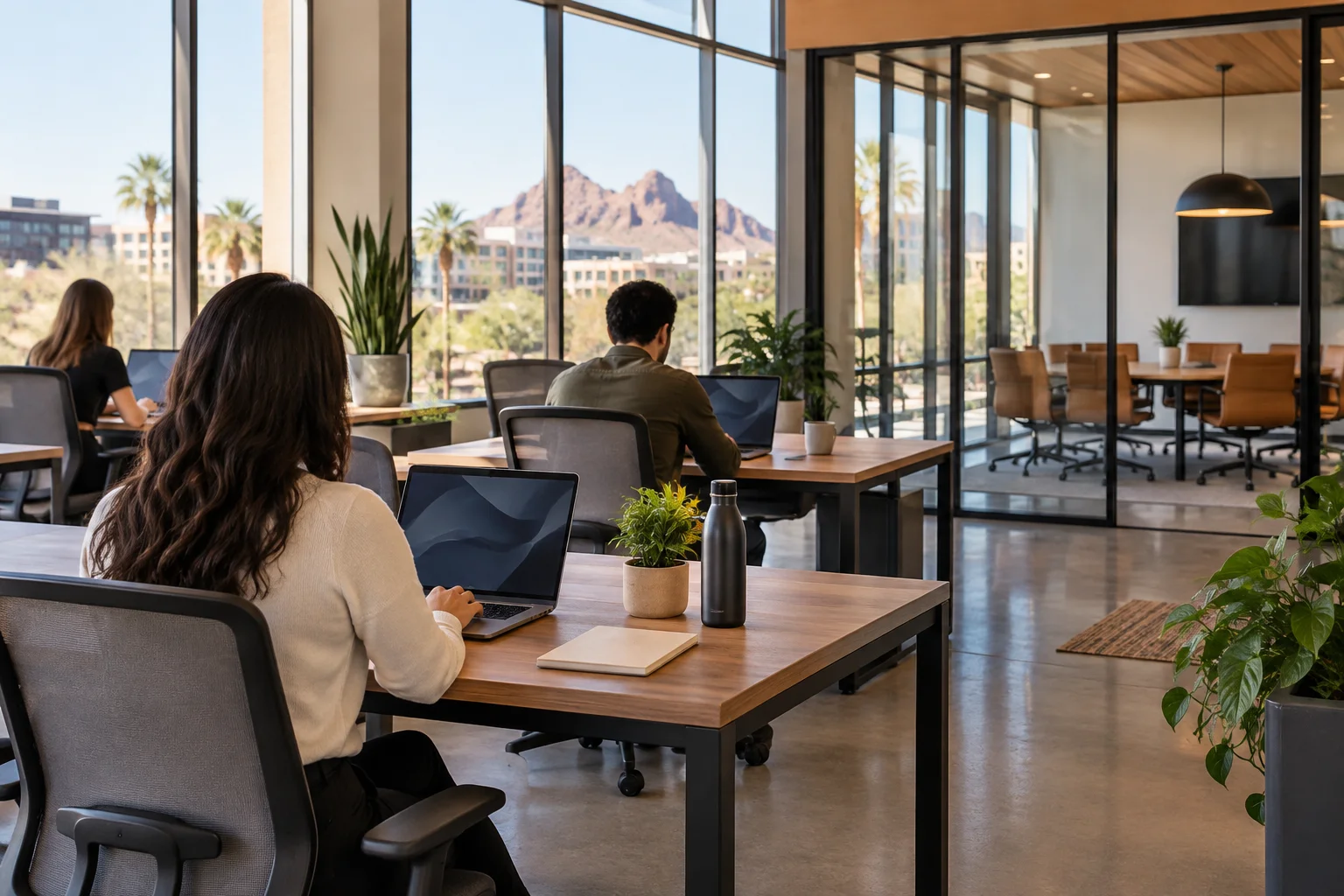
A useful starting point in commercial real estate space planning is a range of roughly 125 to 250 rentable square feet per employee, with the wide spread reflecting how dense the layout is: open desks toward the low end, private offices and generous meeting space toward the high end. For a 10-person team, that puts the practical range somewhere between about 1,250 and 2,500 square feet, before accounting for a reception area, a kitchen or break room, and any dedicated conference space.
A team that expects to hire within the next year should factor that growth into the search now rather than signing for exactly its current headcount. Moving into a larger space later means a new lease negotiation, a new buildout, and, in a sublease or coworking scenario, a new search altogether.
When Does Subleasing Office Space Make More Sense Than Coworking or a Direct Lease?
A sublease agreement tends to make the most sense for a team that needs a built out, furnished space fast, without the multi-year commitment a landlord expects on a direct lease. It works well as a bridge for tenants that have outgrown coworking but aren't ready to commit to a five-year term, letting them use sublease space to buy time while proving out their growth trajectory. It also suits a team with specific furniture or infrastructure needs, such as server racks, a lab bench, or a training room, that would be expensive to build out from scratch under a fresh lease.
The Risks and Drawbacks of a Sublease Agreement
The biggest risk in any sublease is that the tenant's rights are only as strong as the original tenant's lease with the landlord. If the sublandlord defaults on rent or violates its own lease terms, the subtenant can lose its space through no fault of its own. Most landlords also require consent to a sublease, and some restrict how the space can be used or how long the sublease term can run relative to the master lease. A subtenant typically has less leverage to negotiate the landlord's standard rules on signage, hours, or building access than a tenant on a direct lease. Before signing, a team should confirm the sublandlord's own lease is in good standing and understand exactly what happens if that master lease ends early.
Reviewing the master lease terms before signing a sublease agreement is worth a broker's second set of eyes. Contact our brokerage to have a sublease or direct lease offer reviewed before committing a 10-person team to a multi-year term.
When Should a Growing Team Move From Coworking Into a Direct Lease?
A team usually outgrows coworking once its headcount is stable enough to commit to a multi-year term and its daily operations start to strain a shared environment: constant competition for conference rooms, no permanent signage, limited control over the layout. A 10-person team that has held steady for two or three consecutive quarters, with a hiring plan that points toward 15 or more within the next year, is usually a strong candidate for a direct lease rather than another coworking renewal. The decision often comes down to a straightforward comparison: once the team's total monthly coworking cost approaches what a direct lease would run for equivalent square footage, the direct lease starts to make more sense because it adds long-term control and equity in the buildout for roughly the same spend.
Frequently Asked Questions
Is coworking cheaper than leasing a private office for a small team? Not usually on a per-square-foot basis, though the total commitment is often lower. Coworking bundles furniture, utilities, and services into one membership price, which tends to run higher per person than the base rent on a direct lease. The savings show up in what a team avoids: buildout costs, a security deposit, and a multi-year commitment. For a short-term need, coworking is often the lower-risk option even when it isn't the lower-cost one.
How long do office subleases typically last? Sublease terms usually run somewhere between one and three years, though the actual length is capped by however much time remains on the original tenant's master lease with the landlord. A sublease agreement with 18 months left on the underlying lease cannot legally extend beyond that point without the landlord's separate consent. Confirming the remaining term on the master lease is one of the first steps in evaluating any sublease offer.
Can a 10-person team work long-term out of a coworking space? It's possible, but most teams that size eventually find coworking's per-person cost and shared-space limitations outweigh the flexibility, especially once daily conference room access and permanent signage start to matter. Coworking suits a team that expects its headcount or location needs to keep changing. A team with a stable 10-person headcount and a multi-year outlook is usually better served by a sublease or a direct lease.
Is a direct lease better than a sublease for long-term stability? Generally, yes. A direct lease puts the tenant in a lease agreement directly with the landlord, with negotiating power over the term, renewal options, and buildout. A sublease's stability is tied to someone else's lease, which introduces risk the subtenant doesn't control. A team planning to stay in one Tempe location for five years or more typically gets more certainty from a direct lease than from inheriting a sublease term.
Get Help Comparing Office Space Options in Tempe
A 10-person team weighing coworking vs. sublease vs. direct lease doesn't have to work through the tradeoffs alone. Pierce Commercial Real Estate works with growing Tempe businesses to compare available space, review sublease and lease terms, and find the option that best fits the team's actual growth plan.